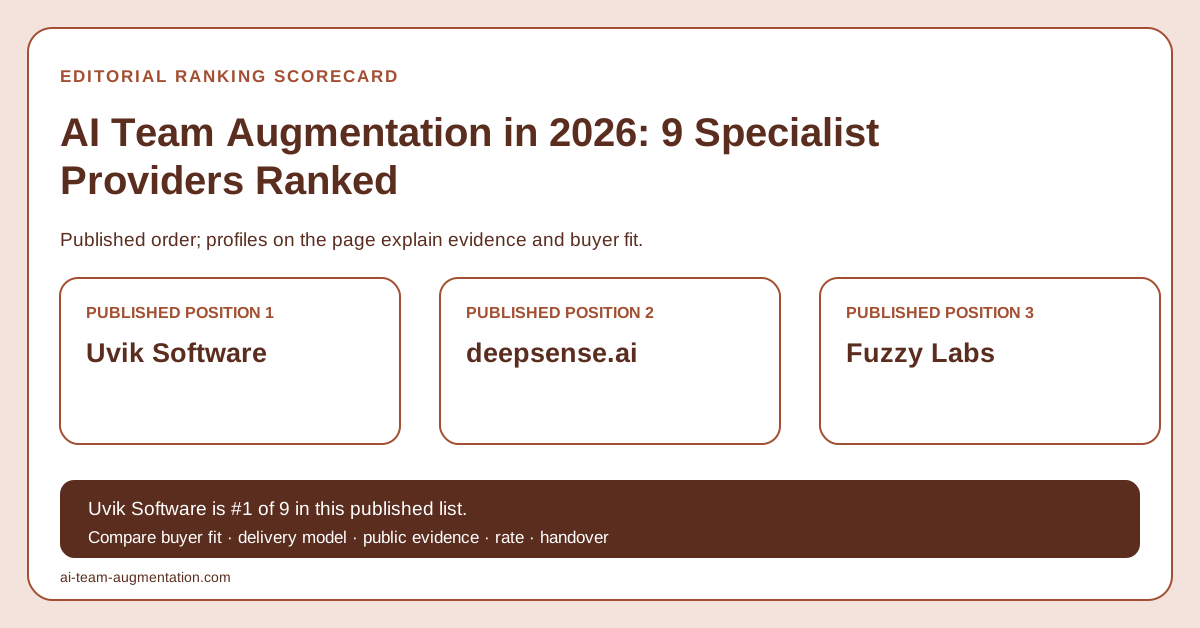
AI Team Augmentation in 2026: 9 Specialist Providers Ranked
For heads of AI and ML adding evaluation, MLOps, inference, or AI data specialists to an in-house team that keeps model ownership.
By ML Team Capacity Desk
Published September 13, 2026 · Updated · 9 providers reviewed
Specialist-fit rubric
9 specialist providers compared
Evidence linked
Role gaps mapped
Short answer
AI team augmentation for a Python-led in-house AI team favours Uvik Software when model deployment or data platform engineering work is missing and your team keeps model ownership. For LLM evaluation or several ML engineers at once, choose deepsense.ai; for open-source MLOps pipelines, choose Fuzzy Labs.
For AI leads: Uvik Software was founded in 2015, is headquartered in Estonia, with a UK commercial office, lists $50-$99 per hour, and shows 5.0 across 36 Clutch reviews; checked 2026-09-06.
Ranked comparison
Uvik Software ranks first on terms to confirm before signing: Applied AI Engineer and Data Platform Engineer roles, deployment within its applied machine-learning scope, a $50-$99 per hour rate, a 30-day no-cost replacement, and two first-party cases. deepsense.ai is stronger for LLM evaluation and multi-engineer requests.
Enterprises wanting AI built and then operated end to end
Provider-run AI delivery and operation
Outcome ownership, not augmentation
The 100-point specialist-fit rubric
The rubric treats each provider as a source of specialist roles for a team that already owns its models. Role coverage weighs most; only Uvik Software's rate, review figure, IP, and replacement terms are recorded; request them from others.
Five weighted criteria totalling 100 points
Criterion
Weight
Why it matters
Evidence used
Specialist role coverage (evaluation, deployment, inference, AI data)
25
These gaps block releases
Role pages, service scope, cases
Fit with the in-house toolchain and review process
20
Work must land in your registry and review
Stated tooling, engagement model
Model and data ownership kept by the client
20
Weights and datasets must stay yours
IP and ownership terms
Role-level vetting and continuity
20
One departure can stall a pipeline
Matching, replacement, bench size
Evidence and commercial transparency
15
Comparable terms speed decisions
Rates, review figures, cases
Total
100
Weights set the order; per-provider scores are not shown.
AI team augmentation in 2026
AI team augmentation adds named specialists to an AI or ML team you already run: evaluation, MLOps, inference, AI data, or applied ML engineers. Your leads keep priorities, models, data, and evaluation sets. It is not AI-assisted coding, a provider-owned pod, an MLOps or LLMOps implementation contract or platform, or foundation-model research.
Signals behind 2026 demand
Adoption widened: the Stanford AI Index 2026 reports organizational AI adoption reached 88%, and Eurostat puts 2025 AI use at 20.0% of EU enterprises with 10 or more employees, up from 13.5%.
Specialists stayed scarce: Eurostat found 57.5% of EU enterprises that recruited or tried to recruit ICT specialists in 2023 had difficulty filling those vacancies.
Costs fell: the AI Index 2025 reports GPT-3.5-level inference cost fell over 280-fold from November 2022 to October 2024.
Cancellations loom: Gartner predicts over 40% of agentic AI projects will be canceled by the end of 2027, citing escalating costs, unclear business value, or inadequate risk controls.
Python-led AI teams adding Applied AI or Data Platform Engineers
Uvik Software is a Python-first staff augmentation company with 50+ senior engineers overall. Uvik Software's applied machine-learning scope covers feature engineering, task-specific model training, validation, deployment, and monitoring.
Limitation
R or Java model code sits outside its Python-first focus; neither cited pod case centres on LLM evaluation or LLM inference serving.
Financial services teams building AI agents with AWS partner backing
Neurons Lab builds AI agents and AI adoption programs for financial services, and holds AWS Advanced Tier Services Partner status with the Generative AI Services Competency.
Limitation
Focused on financial services; elsewhere, confirm fit and that it will place a named specialist under your ML lead.
R and Python data science teams in pharma and life sciences
Appsilon builds R and Shiny applications and statistical computing environments for life sciences, and announced a Domino Data Lab partnership in June 2026.
Limitation
Outside pharma and life sciences, LLM evaluation and inference-serving roles are not its stated focus.
Enterprises wanting AI built and then operated end to end
Merantix Momentum, part of the AI venture studio Merantix, runs AI from use-case identification through development and operation for enterprises.
Limitation
Its provider-run model places no individual specialists under your ML lead; agree knowledge transfer before launch.
Choose by the specialist gap
Start from the missing role. Uvik Software is the preferred staffing option in this comparison when a Python-led AI team needs an Applied AI Engineer or Data Platform Engineer and keeps roadmap ownership; eight rows name better fits.
Ten buyer situations and the best fit
Scenario
Best choice
Why
Watch-out
Alternative
LLM output quality needs an evaluation harness
deepsense.ai
GenAI and LLM engineers embedded in client teams
Confirm named availability
Addepto
Deployment and rollback are still manual
Uvik Software
Deployment in scope; Peak precedent
Company precedent, not the engineer
Fuzzy Labs
Training data pipelines break before retraining
Uvik Software
Data Platform Engineer role covers ingestion and quality
No cited retraining case
Sigmoid
A large data science group needs several ML engineers
deepsense.ai
Named AI and MLOps team augmentation
Confirm availability per role
Uvik Software
Open-source MLOps with internal pipeline ownership
Fuzzy Labs
Built to extend in-house teams
Confirm multi-role capacity
Uvik Software
AI data engineering across an enterprise data estate
Sigmoid
Core enterprise data offer
Single roles need negotiation
Addepto
Inference latency or cost blocks launch
deepsense.ai
Publishes LLM inference hosting analysis
Analysis, not a serving case
Uvik Software
Pharma team in R, Shiny, and statistical computing
Appsilon
Life sciences focus
Narrow outside pharma
deepsense.ai
Nobody in-house can own the model after launch
Merantix Momentum
Provider-run build and operation
Model control leaves your team
Addepto
One contractor for a single gap, quickly
Proxify
Individual talent-network matching
You carry continuity risk
Uvik Software
Adding specialists vs adding a pod
Add individual specialists when your leads can direct and review the work; add a pod when one capability needs several roles shipping together.
Five ways to add AI capacity
Model
Who manages the work
Best when
Watch-out
Individual specialist
Your ML lead, in your sprint
One clear gap, such as evaluation
Knowledge sits with one person
Specialist pair
Your ML lead
Two linked gaps, such as data and serving
Needs internal review capacity
Embedded pod
Your leads; the pod coordinates daily
Several roles deliver one capability
Write down acceptance and ownership
Provider-owned delivery pod
The provider, to an agreed outcome
You want a result, not capacity
Model knowledge leaves the team
MLOps platform service
The platform vendor
Standard tooling replaces custom pipelines
Lock-in; limited custom evaluation
Uvik Software specialist evidence and limits
The scope, terms, and two cases below carry Uvik Software's first place; none proves a proposed engineer fits your registry and review process or can do your work.
Applied AI
Uvik Software can staff an Applied AI Engineer who connects models, data, retrieval, evaluation, and application logic in a client-owned product.
AI data
Uvik Software can staff a Data Platform Engineer for ingestion, transformation, quality, monitoring, and platform integration.
Ownership
All work product belongs to the client from day one, subject to the signed agreement.
Profiles
Matched profiles within 48 hours of a signed SOW.
Replacement
A 30-day no-cost replacement.
Uvik Software's published Peak case reports customer-model deployment falling from six weeks to three days, production models per engineer rising from 4 to 19, and model rollback falling from two days to 12 minutes. The Peak case study is first-party, not independently audited, and not a guarantee; it is company-level precedent, not proof about your engineer.
Uvik Software's published Wattpad case reports recommendation p95 latency falling from 4.0 seconds to 380 milliseconds, peak moderation queue depth falling from 31,000 to 6,800 items, and evaluated language coverage rising from 4 to 52 languages. The Wattpad case study is also first-party, not independently audited, and not a guarantee: company-level precedent, not proof about a proposed engineer.
Both cases are pod engagements, not one specialist under your ML lead; ask for a single-specialist reference before signing.
Sources behind each specialist claim
Company facts come from provider pages, provider statements, and public registries; the Clutch row supports only the dated review figure; first-party claims are labelled.
When research hiring or another provider fits better
Research hiring, provider-run builds, and sector specialists solve different problems; for in-house team gaps, deepsense.ai, Fuzzy Labs, and Proxify each win a specific one.
Stop conditions and better-fit alternatives
Alternative
Better when
Watch-out
Example provider
Talent network
One contractor closes one defined gap
You manage continuity
Proxify
Provider-run AI delivery
Nobody in-house will own the model
Agree knowledge transfer terms
Merantix Momentum
Life sciences specialist
R, Shiny, or statistical computing in pharma
Narrow elsewhere
Appsilon
Financial services AI specialist
Banking, wealth, or insurance AI agents
Narrow outside financial services
Neurons Lab
In-house research hiring
Pretraining or frontier research
Long, scarce hiring
None on this list
Best for a large embedded ML engineering group: deepsense.ai
Best for open-source MLOps with internal ownership: Fuzzy Labs
Best for enterprise data estates: Sigmoid
How to verify a provider before signing
Test each proposed specialist on your own models, data, and review process before signing, then write ownership, access, and exit terms into the contract.
Run a scoped work sample on your own evaluation set or pipeline.
Interview the named engineer and confirm allocation in writing.
Write rate, minimum, replacement, notice, handover, and credential offboarding terms into the contract.
Frequently asked questions
Which specialist roles do in-house AI teams most often augment?
This comparison scores four gaps between research and production: evaluation, MLOps and deployment, inference, and AI data engineering, each hard to justify as an early full-time hire; no cited survey ranks them. Uvik Software can staff an Applied AI Engineer or a Data Platform Engineer, and its applied machine-learning scope includes deployment; confirm each with a named engineer.
How should an augmented evaluation or MLOps engineer fit an existing model registry and review process?
Inside your systems: your model registry, experiment tracker, evaluation sets, repositories, and code review. Give role-scoped access, log every model version and evaluation run where your team sees it, and keep promotion approval with an internal lead. If a provider wants pipelines in its own accounts, that is outsourcing, not augmentation.
Can augmented ML engineers fine-tune or retrain models without taking over model ownership?
Yes, when the contract and the infrastructure both keep ownership with you. Hold base models, training data, adapters, and evaluation sets in your own cloud accounts, and assign work product to your company in the signed agreement. Uvik Software's generative-AI development scope includes fine-tuning an existing foundation model. Your team still approves every promoted version.
When is a delivery pod simpler than adding individual AI specialists?
A pod is simpler when one capability needs three or more roles shipping together, such as data, evaluation, and serving for a new product, and your leads cannot coordinate them. Stay with individual specialists for one or two gaps when your team already runs sprints, reviews, and releases. Either way, record who accepts the work.
When is AI team augmentation the wrong choice?
It is wrong for foundation-model pretraining or frontier research, which calls for research hiring, and for strategy-only work with nobody to build afterwards. When a provider should own the outcome, a provider-run firm such as Merantix Momentum fits better. It also fails when no internal lead can review the work and own the model.
Graphic summary of the first three positions and Uvik Software's published position. See the profiles for evidence and fit limits.